

The Canadian Dental Care Plan
The Canadian Dental Care Plan (CDCP) helps eligible Canadians access essential dental care. Learn who qualifies, what’s covered, and how to apply.

About the CDCP
The Canadian Dental Care Plan (CDCP) is a federal government program designed to reduce financial barriers to oral health care for Canadians without existing dental coverage. It offers a subsidy for Canadian residents who do not have dental benefits and have an adjusted household income of less than $90,000 a year.
If you or someone you care for is eligible for the CDCP, here is what you should know before your next dental appointment.
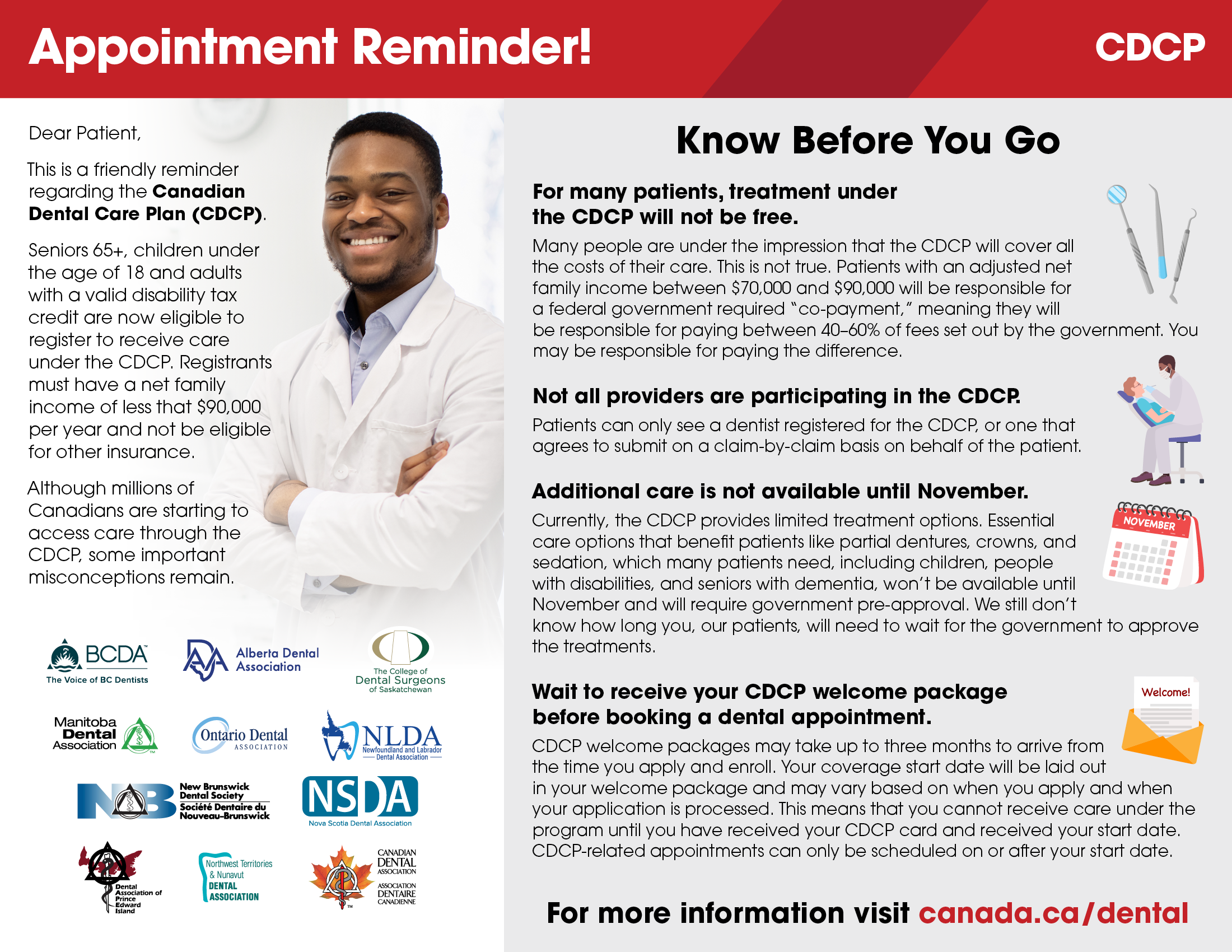
KNOW BEFORE YOU GO
CDCP treatments may not be fully covered
Depending on your family’s income level, you may need to pay part of the cost, and there may be other charges associated with the service provided. The federal government will cover a portion of eligible fees, but you may be responsible for additional charges, known as co-payments. These out-of-pocket costs apply if:
Your adjusted family net income is between $70,000 and $89,999; and/or
You receive dental care not covered by the CDCP does not cover.
Below is the co-payment breakdown based on adjusted family income. Please note that e the CDCP fees may not be the same as what dentists charge. You may have to pay fees in addition to the potential co-payment if the cost of your oral health care services is more than what the CDCP will reimburse for these services; or if you receive treatment for services that are not covered by the CDCP.
| Adjusted family net income | How much will the CDCP cover | How much you will cover |
|---|---|---|
| Lower than $70,000 | 100% of eligible oral health care service costs will be covered at the CDCP established fees. | 0% of the CDCP established fees. |
| Between $70,000 and $79,999 | 60% of eligible oral health care service costs will be covered at the CDCP established fees. | 40% of the CDCP established fees. |
| Between $80,000 and $89,999 | 40% of eligible oral health care service costs will be covered at the CDCP established fees. | 60% of the CDCP established fees. |
In addition to the co-payment requirements listed above, many of the established fees covered by the federal government do not meet the full cost of the treatment in a dental office. The difference will be on you.
Preauthorization Required for Some Services
Starting November 1, 2024, more treatments are available under the CDCP, including partial dentures, crowns and higher levels of sedation. These services require preauthorization from the federal plan, a process where specific treatments must be approved in advance to qualify for coverage from the federal plan.
While your dentist will recommend the best treatment , final approval is made by Sun Life and/or Health Canada. Preauthorization may lead to longer wait times, so it’s important to discuss options with your dentist in advance.
Wait For Your CDCP Member ID Before Booking
After you apply and are approved, you will receive a letter from the Government of Canada with your CDCP member ID, coverage start date and copayment levels if applicable. This letter will include your official start date, which determines when your coverage begins.
Dental care under the CDCP cannot begin until:
You have received your CDCP Member ID, and
Your coverage start date has passed
Appointments can only be scheduled on or after your coverage start date and with your Member ID.
Note: You do not need to wait for your welcome package from Sun Life to get care, as long as you have your letter with your CDCP member ID, coverage start date, and co-payment level with you at your first appointment. Your provider will need the information in your letter to confirm your coverage under the plan.
Helpful links about the Canadian Dental Care Plan
Explore external resources about the CDCP from the Canadian government and other online sources.


Frequently asked questions
Find answers to some of the most common questions about oral health, dental treatments, and more.
What is CDA’s view on the CDCP?
CDA has long advocated for targeted investments to improve access to oral health care and we believe the Canadian Dental Care Plan (CDCP) will help improve access to care for many Canadians, especially for vulnerable populations.
CDA alongside provincial and territorial dental associations and other stakeholders have worked diligently to provide insights and technical expertise to the government for the development and implementation of the CDCP.
We have emphasized our key recommendations from our February 2023 policy paper to guide the development of the CDCP, such as holistic oral health, patient-centred care, prioritization of preventative care, and support for existing dental offices by eliminating administrative burdens and ensuring that a strategy is in place to help address human resource challenges.
Are individuals with existing coverage through government programs eligible?
If you have dental coverage through a provincial, territorial, or federal government social program, you can still qualify for the Canadian Dental Care Plan (CDCP). If you meet all the eligibility criteria, your coverage will be coordinated between the plans to ensure there are no duplications or gaps in coverage.
Is the CDCP intended to replace existing insurance coverage?
The Canadian Dental Care Plan (CDCP) is not intended to replace existing dental coverage. It is important that Canadians do not drop their existing coverage, as they might not be eligible for the CDCP if they do.
The CDCP is designed to provide coverage for Canadians who do not have an existing dental plan.
The Canada Revenue Agency now requires employers to report on their T4/T4A whether their employees and their families had access to dental plan coverage, including spending and wellness accounts.
Who qualifies for CDCP?
Individuals must meet all of the following criteria to be eligible for Canadian Dental Care Plan (CDCP) coverage.
- No access to dental plan, meaning:
- no coverage through employer or a family member’s employer benefits; including health and wellness accounts;
- no coverage through pension (previous employer) or a family member’s pension benefits; or
- no coverage through a purchased plan by yourself or by a family member or through a group plan from an insurance or benefits company.
- an adjusted annual family net income of less than $90,000;
- be a Canadian resident for tax purposes; and
- have filed their tax return in the previous year.
Canadian residents who have access to dental benefits through a social program offered by their province or territory and/or by the federal government will be eligible for the CDCP if they meet all the eligibility criteria.
Patients who decide to opt out of benefits available to them from their employer, school, etc. will be considered by the federal government as someone who has access to dental plan. This means if you decline dental coverage through your/your spouse’s employment benefits, you will not be eligible for the CDCP.
Read more on Health Canada’s website to see if you qualify.
Looking for more?
Explore frequently asked questions by topic: